Elephants use their trunks to eat, drink water, communicate, explore the environment, socialize, and make and use tools. The trunk, which consists of six muscle groups, is not only very strong—it can uproot a tree—but it can be used with great precision. Elephants use a number of techniques to grasp objects, including sucking, pinching with two fingers at the tip of the trunk, and wrapping the trunk around the object.
Researcher Pauline Castes was part of a team of scientists who tested six female African savannah elephants at a zoo to see how much force their trunks exerted and which part of the trunk was stronger. He explains how these findings can be used to improve robots’ ability to grasp and handle objects.
What did you choose to study and why?
In this research project, we investigated the maximum pinch force exerted by the proboscis of African savannah elephants. An elephant’s trunk is mainly composed of muscles, has no rigid structure (no bones) and has many nerves, which gives it great strength, precision and sensitivity.
Previous studies have measured the total force of the trunk when elephants wrap it around an object. We focused on how strong the tip of the torso is. The tip of the elephant’s trunk consists of two finger-like protrusions: one pointed at the top and the other rounder and shorter at the bottom. We also investigated how the position of the trunk affects the force exerted by the elephant.
Read more: Fish fins teach us the secret to flexible robots and new shape-shifting materials
Electronic engineers designing robots have tried to mimic flexibility and the way natural biological tissue can twist or turn while performing various tasks. This is known as bio-inspired technology. For the past 20 years, elephant trunks have inspired research, particularly in robotic grasping and manipulation.
The purpose of our research was to find out how strong the grip of the trunk tip is. This type of grip allows you to pick up small objects with precision. This is particularly useful in soft robotics, which focuses on designing and building robots using flexible and deformable materials inspired by biology.
What were your key findings?
We measured a maximum pinch force of 86.4 N. Newton, the international unit for measuring force, is the force that gives a mass of one kilogram an acceleration of one meter per second squared. In comparison, the maximum pressure force between the thumb and forefinger in humans is between 49 and 68 newtons.
We found that the tip of the trunk is used to grasp objects with high precision but without much force. This is useful information for the future development of soft robot grippers. Some robots need to be able to perceive objects to perform normal activities. The soft grippers – the tool at the end of the robot arm – are the most important gripping component.
Read more: How we built an octopus-inspired surgical robot using coffee
Elephant trunk-based soft grippers also adapt to chaotic and unpredictable environments by reconfiguring their shape. In other words, they adapt their elastic bodies to the objects they interact with.
More research means better clamps. Here are some examples of how to use soft robots:
medicine: Using robots for minimally invasive surgical procedures
Industry: Handling fragile or irregular objects in production lines.
Research and discovery: Development of robots that are able to move in difficult or inaccessible environments.
Agriculture: Harvesting delicate fruits and vegetables without damaging them.
We also found the force difference between the two elephant “toes”. This has never been studied before.
How did you discover this?
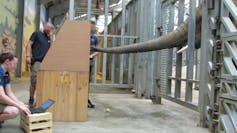
We developed a device to measure the pinching force of the tip of an elephant’s trunk. This box was equipped with two force sensors that were connected to an electronic system. The system recorded the force of the pinch and automatically released the apples as a reward.
Sincerely, Pauline Castes
When the elephant was able to pinch hard enough to pass a predefined threshold, an apple was released. The trunk then had to pinch harder the next time to release the next apple. This was repeated until the elephants reached the maximum force they could achieve.
By placing the sensors vertically and then horizontally on the box, we can see how the elephants grab them in these different directions. This showed us how the position of the trunk affects the force it exerts.
The equipment itself, we spent a lot of time preparing the elephants through training. Tests were done with just the sensors, then prototypes of the box were tested until the final box was functional and reasonably sturdy. After this initial testing phase, conducted by several researchers on our team, I spent three months at the zoo to collect the data needed for this work.
How has your research benefited elephants?
The first direct benefit was to stimulate captive elephants through enrichment activities.
Our research also examined how proboscis capture techniques differ between different groups of elephants living in multiple habitats and the relationship with vegetation density and size. This new knowledge is useful for elephant conservation and helps scientists understand how climate change, which alters elephant habitat, affects their feeding behavior.
This research was carried out in collaboration with the French MECADEV and ISYEB research units at the National Center for Scientific Research, the National Museum of Natural History and the Zooparc de Beauval.
#Elephants #tips #trunks #grasp #objects #great #precision #robotics #design