Authorities are using a growing, powerful, yet controversial forensic method to end the search for a suspect in last year’s murder of Rachel Morin.
Federal officials said at a news conference Saturday that agents crossed international borders after developing a comprehensive DNA profile of the man police believe killed the mother of five while walking the Ma & Pa Heritage Trail last August. to find clues in this case. The 37-year-old’s slaying sent shock waves through Harford County and beyond, focusing national attention on the months-long investigation.
The FBI credits forensic genetic genealogy, a research method that went public in 2018 for identifying the Golden State Killer, with helping them close in on Victor Martinez-Hernandez as a suspect in Morin’s murder. The controversial new technique involves comparing a DNA profile to consumer genealogy databases in addition to law enforcement’s own sources.
While a powerful research tool, it remains largely uncontrolled, raising concerns about genetic privacy.
The technique involves investigators using DNA sequences to create a family tree of a suspect’s possible relatives to gather clues, but it has raised concerns among privacy advocates, who warn that the practice compares evidence with sensitive genetic data of uninvolved individuals. In 2021, Maryland became one of the first states to set limits on forensic genetic genealogy, but the practice remains largely illegal nationwide.
The process involves using forensic evidence to create an accurate DNA profile, which is then compared to data stored in consumer databases. Officials can then try to infer their subject’s relatives, either distant or close, who have uploaded stored genetic data from popular consumer tests such as AncestryDNA and 23andMe.
Natalie Rohm, a law professor at the University of Maryland School of Law in Baltimore, said the new and ever-expanding practice goes beyond traditional expectations of genetic privacy and “has the potential to make us all vulnerable to millions of DNA profiles.” can be found”. It focuses on bioethics.
The genetic profiles used are far more accurate than those processed through the Combined DNA Index System, a law enforcement program known as CODIS, and state, local, and national databases of limited-scope DNA profiles. Manages – Stored genetic material is obtained from evidence from unsolved crimes, missing persons cases and people who have been convicted of a crime.
Some of the sequencing done on murine uses thousands of data points found in DNA, called “markers,” that can be compared to detailed, consumer-focused databases, while CODIS uses only 20 The marker uses and is only able to identify and match DNA samples. Examples available in police databases
Putting the pieces together
Some crime scene evidence was used to ultimately identify Martinez-Hernandez, 23, as the suspect was sent to private labs for evaluation and DNA analysis, according to the Harford County Sheriff’s Office. Some forensic evidence was processed by a private company in Texas.
Othram was founded in 2018 with the goal of using forensic genetic genealogy to solve cold cases and identify homicide victims. The biotech company also runs its own genetic database, DNASolves, which asks people to crowdfund lab tests for cold cases and volunteer their DNA for a database used by law enforcement.
The company’s lab uses a forensic-grade genome sequencing process to build comprehensive DNA profiles from damaged DNA samples commonly found at crime scenes. For active investigations, such as Maureen’s case, law enforcement agencies pay for labs to create genetic profiles from forensic evidence.
Profiles developed through Othram Genome Sequencing allow researchers to go through the generations of a biological family tree to identify the DNA composition and family members of possible suspects in a matter of days.
“We’ve built something that can work with the most untraceable DNA evidence and still create a profile that’s comprehensive enough that you can identify all of a person’s relatives,” said Dr. Kristen Mittelman, Othram’s chief business development officer.
Trail of light and flowers
Karen Jackson/For The Baltimore Sun Media A photo of Rachel Morin along the Ma & Pa trail during the memorial walk Saturday morning decorated with flowers.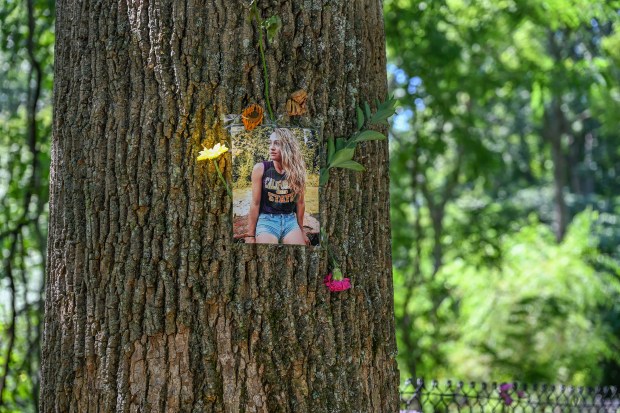
In Maureen’s case, CODIS was used to match DNA found at the Bel Air murder scene with DNA found at a scene in Los Angeles, where a 9-year-old girl and her mother were assaulted during a home invasion. But the suspect’s identity was not available in U.S. law enforcement databases, so investigators consulted Outram.
“Our technology comes into play when someone is not in the database and you need to verify their identity,” Mittleman said.
Once a profile is created, Othram uploads it to law enforcement consent databases much larger than what CODIS provides.
In Morin’s case, the FBI pointed to a call from a suspect with Outram’s profile, Mittelman said. Although researchers have not said how they tracked down Maureen’s killer using the profile, Mittelman said the usual process of obtaining a person’s identity using a genome sequence boils down to “distant relationships” found through database matching. goes.
“When we find distant relatives, we can get a sense of how far away the unknown person is from the matches we get to figure out exactly where they belong,” Mittleman said. “It doesn’t identify a specific person to lead us to the answers. It leads us to be able to fill in the missing piece of the puzzle in the generation that is in the genealogy.”
What the authorities have said so far
Martinez-Hernandez remains in Oklahoma awaiting extradition to face murder and rape charges in Harford County. If the case goes to trial, a brief version of the exact steps investigators took to place Martinez-Hernandez at the scene of Morin’s murder will likely be explained in court within hours.
Meanwhile, court filings and legal arguments could shed light on how Martinez-Hernandez, a native of El Salvador, was identified as a suspect. But investigators have released few details since his arrest Friday at a Tulsa sports bar.
Matt McMahon, the father of Maureen’s oldest daughter, said Harford investigators told him last fall that a genetic family tree analysis determined the suspect was from El Salvador.
William Delbagno, director of the FBI’s Baltimore field office, said Saturday that agents traveled to El Salvador as part of efforts to identify Martinez-Hernandez after the field office’s genetic genealogy research team tracked down possible relatives.
Harford County Sheriff’s spokeswoman Christy Hopkins said Tuesday that the Bel Air and Los Angeles cases were closed with “additional evidence obtained from interviews with family members,” some in El Salvador, after evaluating and analyzing forensic evidence from “multiple sources.” it is related.
Ultimately, the score on May 20, Maureen’s birthday, appeared to be the last major setback, Harford Sheriff Jeff Galler said after the arrest. Galler did not say what information was received that day.
Maryland guardrails for a powerful tool
The advent of forensic genetic genealogy has significantly increased the ability of authorities to identify and locate suspects who cannot be found through traditional law enforcement databases. Othram is sponsoring legislation in Congress that would set aside federal funding for state laboratories to handle forensic genealogy and collect data to measure its success.
“With our profile, we can take one criminal off the streets, and there are victims who come home and the next victim is an unknown criminal who will never know and lead a completely normal life,” Mittleman said. “To me, it means the world.”
But the technique’s considerable investigative power comes from law enforcement using an unprecedented amount of sensitive genetic information from people who are not suspects but have voluntarily entered their DNA into consumer databases, which themselves are based on They market their ability to find ancestry and identify health risks to customers.
Rahm, the Maryland law professor, noted that the practice was entering uncharted territory in terms of consent. Cases like Morin’s, which he called “truly egregious,” are often used to justify the widespread use of those databases, he said.
The rules of engagement are set for law enforcement DNA collection programs such as CODIS, which store very little genetic information compared to what is stored in consumer databases, and are significantly limited in whose DNA profiles are stored. But forensic genetic genealogy depends on DNA volunteered by the suspect’s distant relatives — sometimes second, third or even ninth cousins — who use consumer services for unrelated reasons and may not be aware of law enforcement’s access, Ramm said. .
And although courts have allowed genetic information to be stored in CODIS databases in many circumstances, they have also noted that these DNA profiles are less invasive — they contain little information about a person and are similar to fingerprints. The type of information stored in consumer databases is much broader, Ram said.
Some private services, such as Othram’s DNASolves, only release their genetic databases to law enforcement. The most popular consumer platforms, Ancestry and 23andMe, resist law enforcement requests without a court order, subpoena or warrant. GEDMatch and FamilyTreeDNA, sites where users can upload their data to bypass separate consumer services, have become popular platforms for legal genetic genealogy, although they now require authorities to pay for a limited account and only access users’ data. indicate that they have chosen to share information. with law enforcement
But because genetic genealogy research is set up in a decentralized manner, researchers can simply ignore the terms of service and use the platforms under the guise of a regular user, Ram said.
Most states have no laws setting boundaries for how forensic genetic genealogy is performed. The United States Department of Justice has developed temporary regulations to implement federal law.
Rahm, who is pushing for bipartisan legislation to pass in 2021, said Maryland is “responsible for regulating and formalizing” the practice.
Maryland law requires that this technique be done only with the approval of a judge. The law requires officials to testify under oath that the technique is used to investigate certain major crimes — murder, rape and other ongoing threats to public safety — and use databases that require users to verify their information. which can be used by law enforcement.
#forensic #genetic #genealogy #technique #Rachel #Morins #case #slightly #adjusted