The destruction of the Hubble Space Telescope will probably always be like this: parts fail one by one and there is no way to replace them. Over the past few months, Hubble has repeatedly gone into safe mode because one of its three remaining gyroscopes kept giving faulty readings. But Hubble and the people who run it are flexible and resourceful. The telescope is now back in science operation, albeit in single-gyro mode.
NASA has released the first image taken by Hubble in this mode and it is clear that Hubble is doing well.
This image is Hubble’s contribution to the observational effort with three telescopes and several wavelengths. The James Webb Space Telescope (JWST-infrared) and the Atacama Large Millimeter/submillimeter Array (ALMA-radio) are both involved. Hubble captured this image with its Wide Field Camera 3 (WFC3).
“A new Hubble image of a spectacular galaxy shows the complete success of our new, more stable pointing mode for the telescope.”
Dr. Jennifer Wiseman, Hubble Project Scientist, NASA Goddard Space Flight Center
This image shows the lenticular galaxy NGC 1546, located 61 million light-years away in the constellation Dorado. The orientation of the galaxy is such that the glow of its core illuminates the dust lines. Dust absorbs starlight and then re-emits it at lower wavelengths, making the dust appear brown. The core is yellowish, which represents the population of old stars. The bright blue regions emerging from the dust lines are where active star formation is taking place. Background galaxies are also visible, including an edge-on view of a reddish spiral galaxy on the left.
Hubble began its mission with six gyroscopes that help the telescope point itself toward selected targets. Now there are only three people left and one of them is causing trouble many times. NASA says the gyroscope is experiencing “saturation,” meaning that Hubble is at its maximum speed regardless of the actual rate of motion.
But as this image shows, science operations are still effectively underway, even though NASA says there are minor limitations in single-gyro mode. In this case, the telescope’s view is limited to some areas of the sky. Single gyro mode is part of the telescope design, only if four or five of the six gyros fail.
It is amazing that a space telescope can work with a gyroscope. It can absorb light from objects billions of light-years away as it travels at 27,000 km/h (17,000 mp/h). All the while, he keeps his gaze steady. NASA describes it as shining the laser more than 320 kilometers (200 miles) away. Telescopes require long exposure times. Sometimes, it focuses on one time for 24 hours.
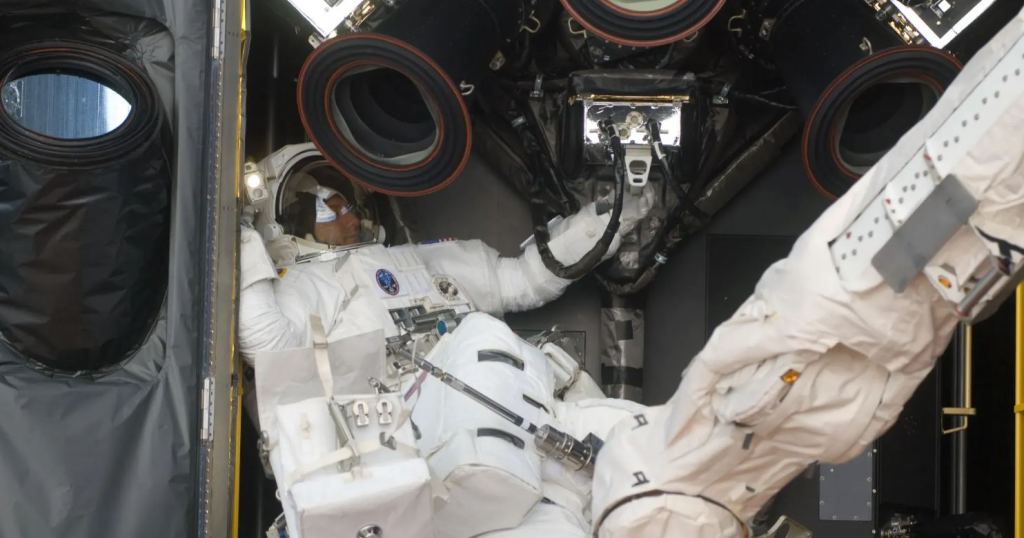
This is the second set of six Hubble gyroscopes. They were all replaced during a service mission in 2009.
“Hubble’s new image of a spectacular galaxy demonstrates the complete success of our new, more stable pointing mode for the telescope,” said Dr. Jennifer Wiseman, Hubble’s chief project scientist at NASA’s Goddard Space Flight Center in Greenbelt, Maryland. We are now ready for many discoveries and will explore everything from our solar system to exoplanets to galaxies far away. Hubble plays a powerful role in NASA’s astronomical toolbox.
Everything has a beginning and an end, including Hubble. Over time, the gyroscope and other equipment will continue to fail. Just like other older spacecraft, such as the Voyager probes, engineers and mission staff will adapt and find new ways to keep the telescope working, possibly with less results. But one day, the space telescope will fail.
Given all that Hubble has contributed, it will be a very sad day when the telescope shares its final image with us.
#image #Hubble #pointing #mode