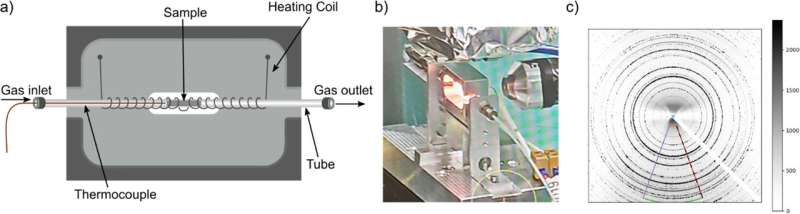
In situ XRD setup. (a) The sample is placed in an alumina tube. A thermocouple inside the tube is used to measure the temperature and a coil wrapped around the tube is used for heating. The holding cover is metal with front and back openings for the X-ray beam, and air passes through the tube during heating and measurements. (b) A hot sample in the sample stage during the measurement. (c) An example of the experimental model. Colored lines enclose the part of the pattern image used for merging. credit: Journal of Electrochemical Society (2024). DOI: 10.1149/1945-7111/ad3aa9
Switching from gas-powered cars to electric cars is one way to reduce carbon emissions, but manufacturing the lithium-ion batteries that power these electric cars can itself be an energy-intensive and polluting process. Now researchers at Dalhousie University have developed a manufacturing process that is cheaper and greener.
“Manufacturing lithium-ion cathode materials consumes a lot of energy and water and produces waste. This material has the greatest impact on the environment, especially CO2.2 Battery footprint.
We wanted to see if there were more environmentally friendly, sustainable and less expensive ways to make these materials.
Most electric vehicle batteries use lithium nickel nickel cobalt oxide (NMC), the elements of which are mixed in the crystal structure of the cathode. They are usually made by dissolving the elements in water and then using the crystals that form when the elements solidify.
This process requires a lot of water – which must then be treated to clean it – and energy, which is the main source of the batteries’ cost and carbon footprint. Using the Canadian Light Source (CLS) at the University of Saskatchewan, Obrovac and his team investigated whether they could use a completely dry process to achieve the same results while saving energy, water and money.
Their work has been published in two papers, in ACS Omega And Journal of Electrochemical Society.
“We wanted to see if you could take the dry ingredients and combine them with simple processes that you would find in any large factory and heat them up, could you get the same quality?” he says. “And under what conditions can you do this to obtain trade materials while cutting off water and waste?”
Cathodes made from dry materials are sometimes not as homogeneous as cathodes made in water, so the team tried different methods using different oxides and thermal regimes at different temperatures and pressures to determine what worked best.
They used the Brockhouse beamline at CLS to look inside the furnace and performed various experiments to see exactly what was happening during the process. “What we found was important information about how we can improve the process so that what comes out is a higher-grade NMC-type cathode material,” says Obrovac.
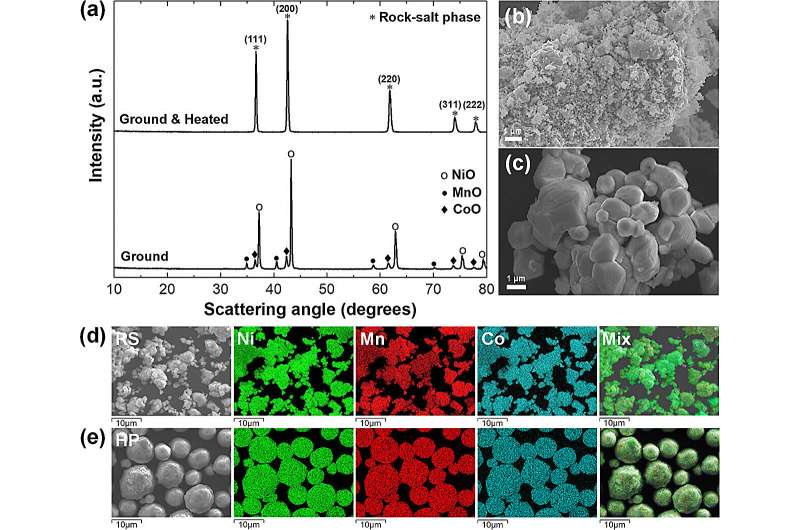
(a) XRD patterns of mixed NiO, MnO and CoO powders after milling for 3 h and after heating to form RS precursors. SEM images of NiO, MnO and CoO powder mixture after (b) 3 h milling and (c) after heating to form RS precursor. SEM images and associated EDX mapping of Ni, Mn, and Co for (d) RS precursor and (e) HP precursor.ACS Omega (2023). DOI: 10.1021/acsomega.3c08702
The highest quality cathodes currently available are made of single crystals with particles about 5 microns in diameter. By fine-tuning the raw materials and furnace conditions, the Obrovac team was able to reproduce those qualities using a completely dry process, comparing the cathode materials to the best materials on the market today.
Obrovac has partnered with Nova Scotia-based battery company NOVONIX, which uses dry processes to produce cathode materials at the company’s test facility in Dartmouth. The facility is capable of producing 10 tons of cathode material per year, with methods that have 30% lower capital costs than conventional (wet) methods, 50% lower operating costs, and 25% lower energy consumption, while requiring no process. . Zero water and waste generation.
“These are big numbers, it’s a very big change in the production of these battery materials,” says Obrovac. “In general, lower-cost batteries should have significantly lower global warming footprints.”
more information:
Mohammad H. Tahmasabi et al., New insights into the all-dry synthesis of NMC622 cathodes using a single-phase rock salt oxide precursor, ACS Omega (2023). DOI: 10.1021/acsomega.3c08702
Ido Ben Barak et al., Total dry synthesis of NMC from [Ni,Mn,Co]Spinel precursors 3O4, Journal of Electrochemical Society (2024). DOI: 10.1149/1945-7111/ad3aa9
Provided by Light Source Canada
quotation: New process makes battery production more eco-friendly (2024, June 20) Retrieved June 21, 2024, from https://techxplore.com/news/2024-06-battery-production-eco-friendly.html
This sheet or document or writing is covered by copyright law. Except for any fair dealing for the purpose of private study or research, no part may be reproduced without written permission. This content is created for informational purposes only.
#battery #manufacturing #process #environmentally #friendly