NASA is very interested in developing a propulsion method that would allow spacecraft to move faster. We’ve reported several times on various ideas to support this goal, and most of the more successful ones have made good use of the Sun’s gravity, usually by shooting around it, as is currently being done with Jupiter. But, there are still significant obstacles to doing this, not least of which is that the energy radiated from the Sun simply vaporizes anything that gets close enough to it to use a gravitational assist. That’s the problem that a project supported by NASA’s Institute for Advanced Concepts (NIAC) and led by Jason Benkowski, now of Lawrence Livermore National Laboratory, is trying to solve.
The project received a NIAC Phase I grant in 2022 focusing on combining two separate systems – a heat shield and a thermal propulsion system. Combining the two technologies could allow a spacecraft to perform what is known as an Oberth maneuver around the Sun, according to the project’s final report. In this orbital mechanics trick, a spacecraft makes good use of the Sun’s gravity to launch itself at high speed in the direction it is aiming. This is similar to the Sundiver technology discussed in other articles.
So, what makes this project unique? One thing is the heat shield – Dr Benkowski and his team developed a material that can withstand up to 2700 Kelvin. While still nowhere near the temperature of the Sun’s surface, which can reach up to 5,800 Kelvin, it is enough. to get close enough, thereby opening up the spacecraft’s ability to use the Oberth maneuver in the first place.
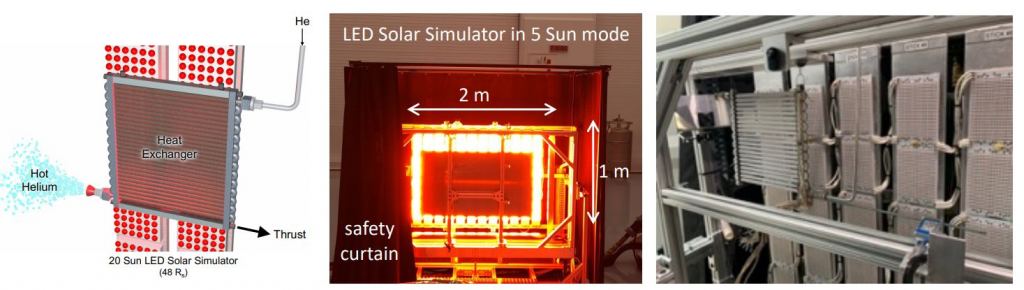
Credit – Benkoski et al.
Examples of materials with these thermal properties have already been produced. However, more research is needed to understand whether they are cut out for spaceflight. And a heat shield alone isn’t enough to accomplish this maneuver—a spacecraft must also have a propulsion system that can withstand those temperatures.
A solar thermal propulsion system could potentially do this. These systems use the sun’s energy to pressurize their propellants and then eject those propellants to obtain the thrust necessary for the Oberth maneuver. There are many different types of fuel that could work for such a system, and a large part of the research in the Phase I project looked at the various costs/benefits of each.
Hydrogen is one of the most common fuels considered for solar thermal propulsion. Although it is lightweight, it requires a bulky cryogenic system to store hydrogen as it heats up enough to be used as propulsion. In the end, its trade-offs made it the least effective of the engines considered during the project.
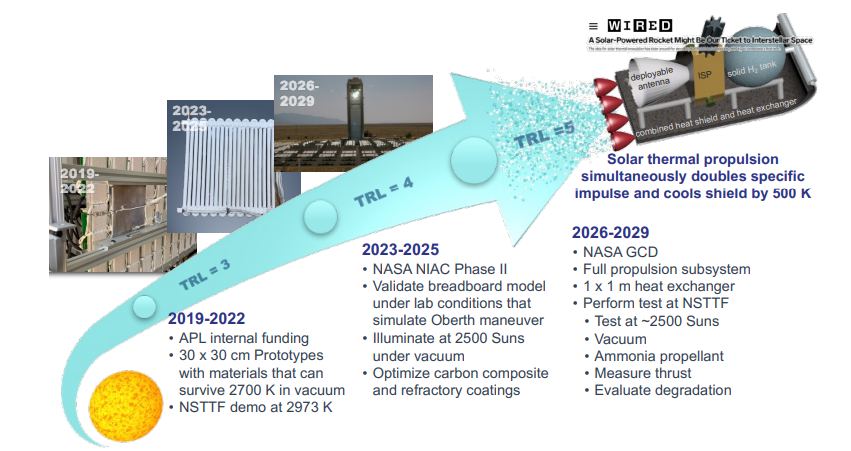
Credit – Benkoski et al.
Lithium hydride was the surprise winner for the fastest escape velocity fuel. Calculations show that it can lead to a speed of more than 12 AU/year. However, there are restrictions on fuel storage and handling.
As the overall winner of the modeling he did, Dr Benkowski solved for a more common fuel – methane. While it generally results in a slower terminal velocity than lithium hydride, its terminal velocity is still respectable at over 10 AU/year. It also eliminates many of the storage problems of other propellants, such as the cryogenics required to store hydrogen.
However, there are some drawbacks – the calculated top speed is only about 1.7 times faster than what was previously done with Jupiter’s gravity-assisted, which doesn’t require fancy thermal shielding. However, there are other downsides to it, such as the direction in which the spacecraft can move is limited to where Jupiter is in relation to other objects of interest. On the other hand, by orbiting the Sun, any point in the solar system and beyond can be reached with a properly controlled burn.
As Dr. Benkoski notes in the final report, he made many assumptions when performing his modeling calculations, including that the system could only use developed technologies rather than speculative technologies that could dramatically affect the results. At this time, it does not appear that NASA has selected the project to move to Phase II, and it is unclear what future work is planned for further development. If nothing else, it’s a step toward understanding what it would take to send a spacecraft past the Sun and into deep space at speeds far faster than anything that’s been done before. Due to NASA’s continuous attention to this issue, no doubt one of the missions will succeed in doing it one day.
Know more:
Benkoski et al – Combined Heat Shield and Solar Thermal Propulsion System for Oberth Maneuver
UT – Tiny spacecraft using solar sails opens up a solar system of opportunity
UT – Want the fastest solar sail? First throw it in the sun
UT – A mission to reach the Sun’s gravitational lens in 30 years
Lead image:
Graphics of a solar thermal propulsion system undergoing an Oberth maneuver around the sun.
Credits – Jason Benkowski
#Shooting #sun #spacecraft #faster