The world’s oldest animal welfare charity, the Royal Society for the Prevention of Cruelty to Animals (RSPCA), is under fire from non-human rights activists Animal Rising.
A food labeling scheme, RSPCA Assured, labels meat and dairy from farms subject to annual inspections by trained officials. At more than 40 farms in the UK supported by the label, which indicates a farm inspected to “higher welfare standards”, Animal Rising research has reportedly documented dead and dying animals.
An RSPCA Assured spokesperson is reported to have said that investigations are ongoing and welfare breaches are rare on accredited farms.
Read more: RSPCA Assured: Animal welfare labels are a money maker for supermarkets
Ethical meat eating is apparently more complicated than checking labels at the supermarket. But, you may wonder, what does this have to do with the weather?

This summary of The Conversation’s climate coverage comes from our weekly climate action newsletter. Every Wednesday, The Conversation’s environment editor writes Imagine, a short email that delves a little deeper into just one climate topic. Join over 30,000 readers who have subscribed.
First, let’s consider what life is like for farm animals.
Living on a caged planet
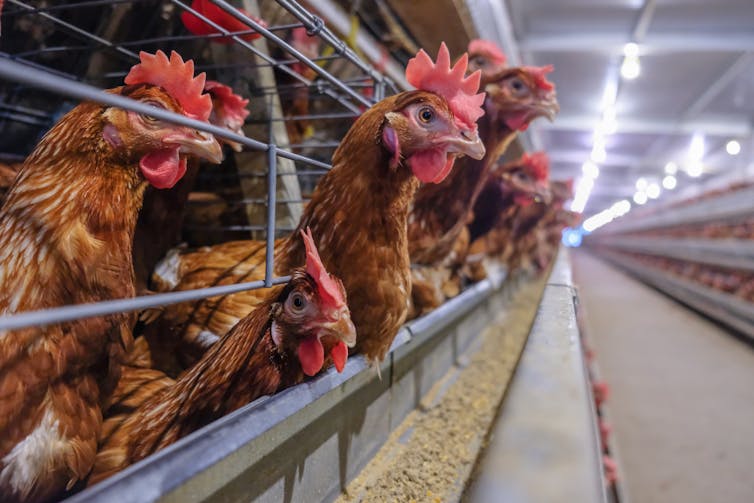
More than 100 billion animals are killed for food worldwide each year – hundreds of millions of animals per day. According to Hannah Ritchie, a global food systems researcher at the University of Oxford and our deputy editor, three-quarters of land livestock (23 billion cows, chickens, turkeys and pigs) and almost all farmed fish spend their lives before being slaughtered in factory farms. do The world in data
Factory farming involves raising animals in enclosed spaces with little or no access to the outside world. The collective weight of captive animals raised for food dwarfs the weight of the planet’s wild animals. That means, just by sheer numbers, the average experience of living on Earth, at least for vertebrates, is that of an animal in a cage, says Wired writer Andy Greenberg.
Mai.Chayakorn/Shutterstock
The RSPCA estimates that scientists experiment on 100 million animals (mostly mice and rats) every year – 0.1% of the number killed for food. Keith Chatfield, vice-chancellor of the Center for Professional Ethics at the University of Central Lancashire, says this small group are relatively lucky.
Unlike farm animals, the welfare of laboratory animals is (at least conceptually and in the EU) governed by an ethical code that can be summarized by the three Rs: replacement, reduction and rehabilitation. Where possible, replace animal testing with other methods, reduce the number of animals used, and modify their treatment to eliminate unnecessary suffering.
Read more: Double standards in animal ethics: Why are lab mice better protected than cows?
“The three R’s are widely accepted by scientists and the general public as a reasonable measure of ethical acceptability,” says Chatfield. So what happens if we apply this minimum standard to farm animals?
That means replacing animal products with alternative foods, and where none exist, eating only as much animal food as nutritional needs dictate, Chatfield says. Incidentally, the Intergovernmental Panel on Climate Change, or IPCC, says something similar about the ideal diet to put the brakes on global warming.
Four-legged allies
Meat can be a nutritious source of protein and iron, but there are many alternatives. Plant-based proteins are almost as good for building muscle as animal-derived proteins.
Read more: What is the best source of protein for muscle building, meat or plants?
Better yet, growing legumes like beans, lentils, and peas can return vital nutrients to the soil and reduce the need for climate-damaging fertilizers and water pollution.
Read more: Why the humble legume could be the answer to Europe’s fertilizer addiction
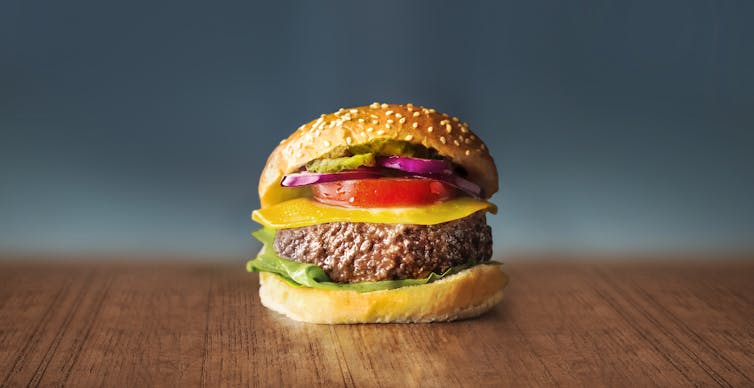
There are even meat substitutes that look and taste like real meat.
“New technologies are being developed that are enabling a system-wide revolution in food production,” said Chris D. Thomas, Jack Hatfield and Katie Noble of York University’s Center for Anthropocene Biodiversity.
The team refers to cellular agriculture, or “lab-grown food,” which involves growing meat and dairy products using real animal cells. Thomas’ research showed that this approach could meet the growing global demand for 20 percent of available agricultural land, freeing up much of the remainder for wildlife habitat that can sequester and sequester planet-warming carbon in the atmosphere.
Mosa Meat/Shutterstock
Read more: New food technologies could return 80% of the world’s agricultural land to nature
According to Jo Wills, a legal researcher at the University of Leicester, there is a limit to what welfare regulations can achieve for farmed animals.
He says: “When sentient beings are reduced to productive units and caught in the frenzy of economic exploitation, their lives are always marked by suffering, health and deprived freedoms.”
Read more: Cow documentary shows the necessity of fundamental and legal rights for animals
And as far as weather is concerned, keeping animals in cages has an opportunity cost.
Heather Albro, lecturer in sustainable development at Nottingham Trent University, said: “Recent research has highlighted the role of animals in nature in keeping climate-warming gases such as CO2 out of the atmosphere.
“For example, wildebeests migrating in the Serengeti in Africa consume large amounts of grassland carbon, which is returned as dung and incorporated into the soil by insects.”
Read more: Major national protests: Animal uprising activists show how animal exploitation hurts us
Given the opportunity to rediscover their wild behavior, future generations of domesticated mammals can contribute to the greatest task of the 21st century: restabilizing the Earth’s climate and biosphere.
#animal #ethics #important #dealing #climate #change