Since its launch in 2022, James Webb Space Telescope (JWST) has revealed amazing things about the universe. The latest was when a team of researchers used it the WebThe Mid-Infrared Instrument (MIRI) to observe Rho Ophiuchi, the closest star-forming nebula to Earth, about 400 light-years away. While at least five telescopes have studied the region since the 1970s, the WebUnprecedented clarity and specialized instruments revealed what is happening in the heart of this nebula.
To begin with, while observing what was thought to be a star (WL 20S), the team realized that they were observing a pair of young stars that formed between 2 and 4 million years ago. The MIRI data also showed that the twin stars have fountains of hot gas (known as stellar jets) pouring out into space from their north and south poles. The discovery was presented at the 244th meeting of the American Astronomical Society (224 AAS) on June 12. Thanks to additional observations made by the Atacama Millimeter/submillimeter Array (ALMA), the team was surprised to see large clouds of dust and gas surrounding both stars.
Based on the age of the twins, the team concluded that they may be circumstellar disks that are gradually forming a system of planets. This makes WL 20S a valuable find for astronomers, allowing them to watch the solar system form. As noted, the Ru-Ophioshi Nebula has been studied for decades by infrared telescopes, including the Spitzer Space Telescope and the Wide Field Infrared Survey Explorer (WISE), Infrared Telescope Facility (IRTF) at Mauna Kea Observatory, Hall 5.0 . Palomar Observatory Telescope and Keck II Telescope.
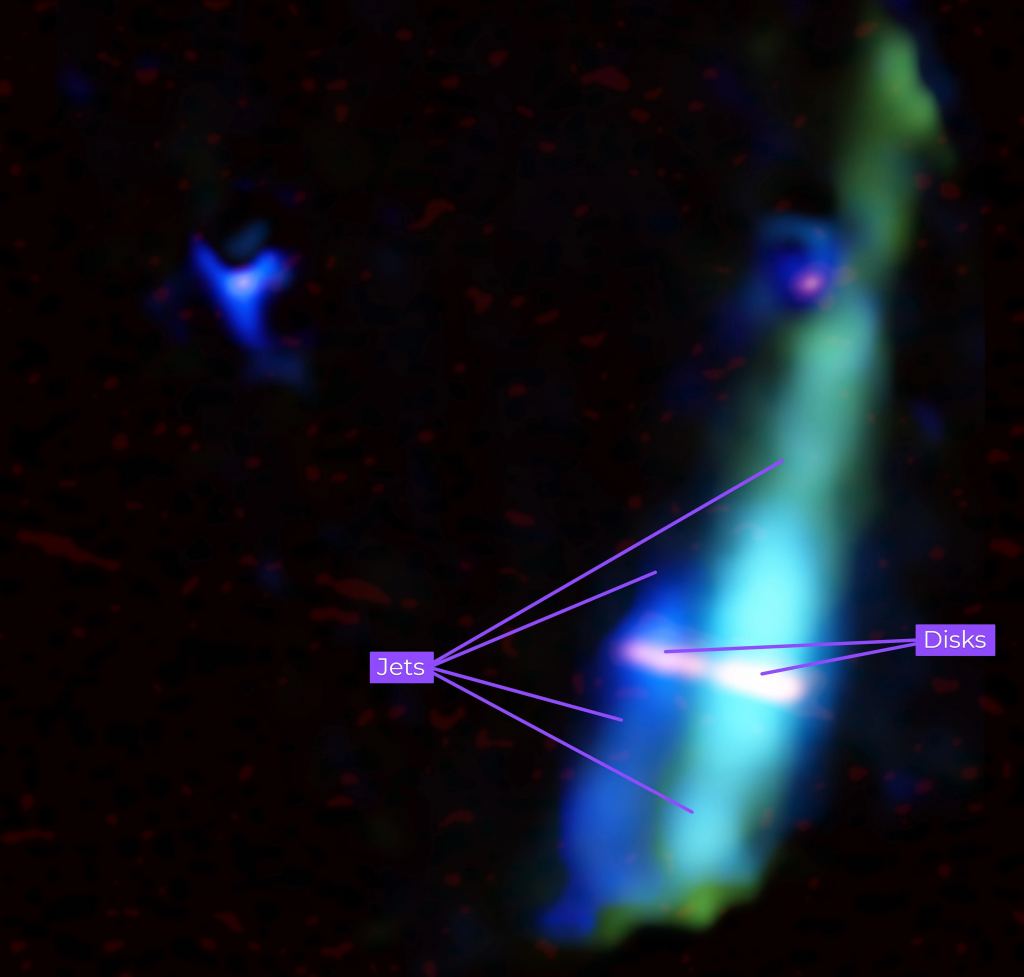
Infrared astronomy is essential when studying dusty nebulae because clouds of dust and gas obscure most of the visible light from stars. Thanks to its advanced infrared optics, the Web He was able to detect slightly longer wavelengths using the MIRI instrument. Mary Barsoni, an astronomer at the Carl Sagan Center for the Study of Life in the Universe (part of the SETI Institute), was lead author of a new paper describing the results. As he said in a recent NASA press release.
Our jaws dropped. After decades of studying this resource, we thought we knew it pretty well. But we didn’t know if it was two stars or if these jets existed without MIRI. This is truly astounding. It’s like having brand new eyes.”
Radio telescopes are another way to study nebulae, although they are not guaranteed to reveal the same features as infrared instruments. In the case of WL 20S, the absorbed light was visible in the sub-millimeter range, making ALMA the ideal choice for further observations. However, high-resolution infrared data were needed to identify WL 20S as a pair of stars with individual accretion disks. This allowed the team to detect stellar jets composed of ionized gas that are not visible at submillimetre wavelengths.
The power of these two telescopes together is really incredible. If we hadn’t seen that they were two stars, the ALMA results might have just looked like a disk with a gap in the middle. “Instead, we have new data on two stars that are clearly at a critical point in their lives, when their formation processes are collapsing.”
The combined MIRI and ALMA results showed that the twin stars are nearing the end of their formation period and may already have a system of planets. Future observations of these stars with the Web And other telescopes are allowing astronomers to learn more about how young stars transition from formation to their main sequence stage. “It’s amazing that this region still has so much to teach us about the life cycle of stars,” Ressler said. “I’m excited to see what else the web will reveal.”
Read more: NASA
#Identical #twin #stars #launch #jets #space